
İkinci El
Raymond-Claude-Ferdinand Aron (14 March 1905 – 17 October 1983) was a French philosopher, sociologist, journalist, and political scientist.
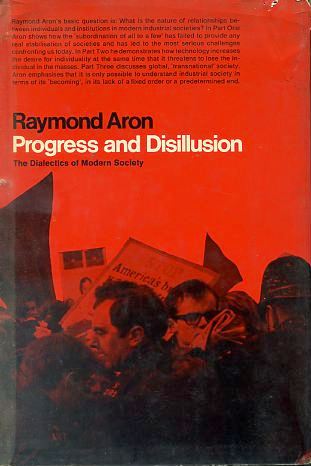
Progress and Disillusion: The Dialectics of Modern Society, by Raymond Aron, was first published in 1965, and was intended to respond to a series of enigmas: why was it that the prosperity of the post-war years, which were characterized by economic growth, full employment, and the generalization of social protection, engendered so much frustration and unrest in society? Why was it that there was so much talk of inequality when it was decreasing progressively? Why was it that the theses of alienation, domination, and enslavement were so common, although never before in history have the conditions of emancipation and self-affirmation been so favorable? How is it, finally, that at a time of the globalization of trade, the need to search for authenticity in the specificities and traditional forms of identity is so prevalent? Aron’s responses enlightened many sociologists, to the point that today several of them see this book as an essential contribution to the understanding of modern societies. However, until now there has been no systematic re-reading of it. Such was the exercise that gathered three young sociologists–Nicolas Duvoux, Cécile van de Velde, and Marion Ledoux-Wlodarczyk–at a round table discussion under Serge Paugamon on the occasion of a study day on Raymond Aron that took place on June 14, 2012 at the EHESS, on “Science and conscience of society. The transformations of French society since 1960.” Nearly fifty years after the publication of the English version, the four authors return to the three dialectics analyzed in the three parts that make up the book (equality, socialization, and universality) and attempt to test this analytic framework by holding it up to the issues in French sociology today, as well as to the tensions that permeate the whole of society.
İkinci El
Raymond-Claude-Ferdinand Aron (14 March 1905 – 17 October 1983) was a French philosopher, sociologist, journalist, and political scientist.
Progress and Disillusion: The Dialectics of Modern Society, by Raymond Aron, was first published in 1965, and was intended to respond to a series of enigmas: why was it that the prosperity of the post-war years, which were characterized by economic growth, full employment, and the generalization of social protection, engendered so much frustration and unrest in society? Why was it that there was so much talk of inequality when it was decreasing progressively? Why was it that the theses of alienation, domination, and enslavement were so common, although never before in history have the conditions of emancipation and self-affirmation been so favorable? How is it, finally, that at a time of the globalization of trade, the need to search for authenticity in the specificities and traditional forms of identity is so prevalent? Aron’s responses enlightened many sociologists, to the point that today several of them see this book as an essential contribution to the understanding of modern societies. However, until now there has been no systematic re-reading of it. Such was the exercise that gathered three young sociologists–Nicolas Duvoux, Cécile van de Velde, and Marion Ledoux-Wlodarczyk–at a round table discussion under Serge Paugamon on the occasion of a study day on Raymond Aron that took place on June 14, 2012 at the EHESS, on “Science and conscience of society. The transformations of French society since 1960.” Nearly fifty years after the publication of the English version, the four authors return to the three dialectics analyzed in the three parts that make up the book (equality, socialization, and universality) and attempt to test this analytic framework by holding it up to the issues in French sociology today, as well as to the tensions that permeate the whole of society.